
AI vs. Automation: Understanding the Key Differences and Applications
Alright, I know what you’re thinking: “AI vs. automation? Isn’t that like comparing Batman to Batman’s utility belt?” Well, sort of. Though closely related, AI and automation have distinct roles — and understanding these can save you headaches and money.
So, buckle up! Let’s unravel these buzzwords with some clarity (and maybe a joke or two).
Curious where AI could fit in your business? **Book a free 30-minute automation audit.
📩 darrenjohns@productivityloop.ai
What Is Automation?
Think of your Roomba programmed to clean your living room every day at 3 PM sharp. It executes exactly what you instructed, no more, no less. That’s automation.
Automation uses technology to perform tasks with minimal human involvement. It’s like a reliable robot coworker who sticks to the script unless reprogrammed. Examples include:
- Robotic Process Automation (RPA): Virtual assistants managing forms and data entry tirelessly.
- Industrial Automation: Factory robots assembling products, handling monotonous tasks.
- Home Automation: Smart thermostats adjusting temperatures before you even notice.
Summary: Automation is your obedient tech tool that boosts efficiency and reduces errors — but it won’t decide when to take breaks.
Want to trial automation without overwhelm? **Ask about our Productivity Starter Pack**—your first workflow live in under 2 hours.
📩 darrenjohns@productivityloop.ai
What Is AI?
AI is less about following scripts and more about learning and adapting. AI systems think (as much as machines can) and improve over time. It’s like the difference between a parrot repeating phrases and a toddler figuring out new ways to ask for snacks.
Key AI types include:
- Machine Learning (ML): Training machines to learn patterns and predict outcomes from data.
- Natural Language Processing (NLP): Enables phones and chatbots to understand and respond to human language.
- Computer Vision: Recognizes images and objects automatically, like social media tagging your photos.
Summary: AI is the smart assistant that analyzes, adapts, and makes autonomous decisions.
The Key Differences Between AI and Automation
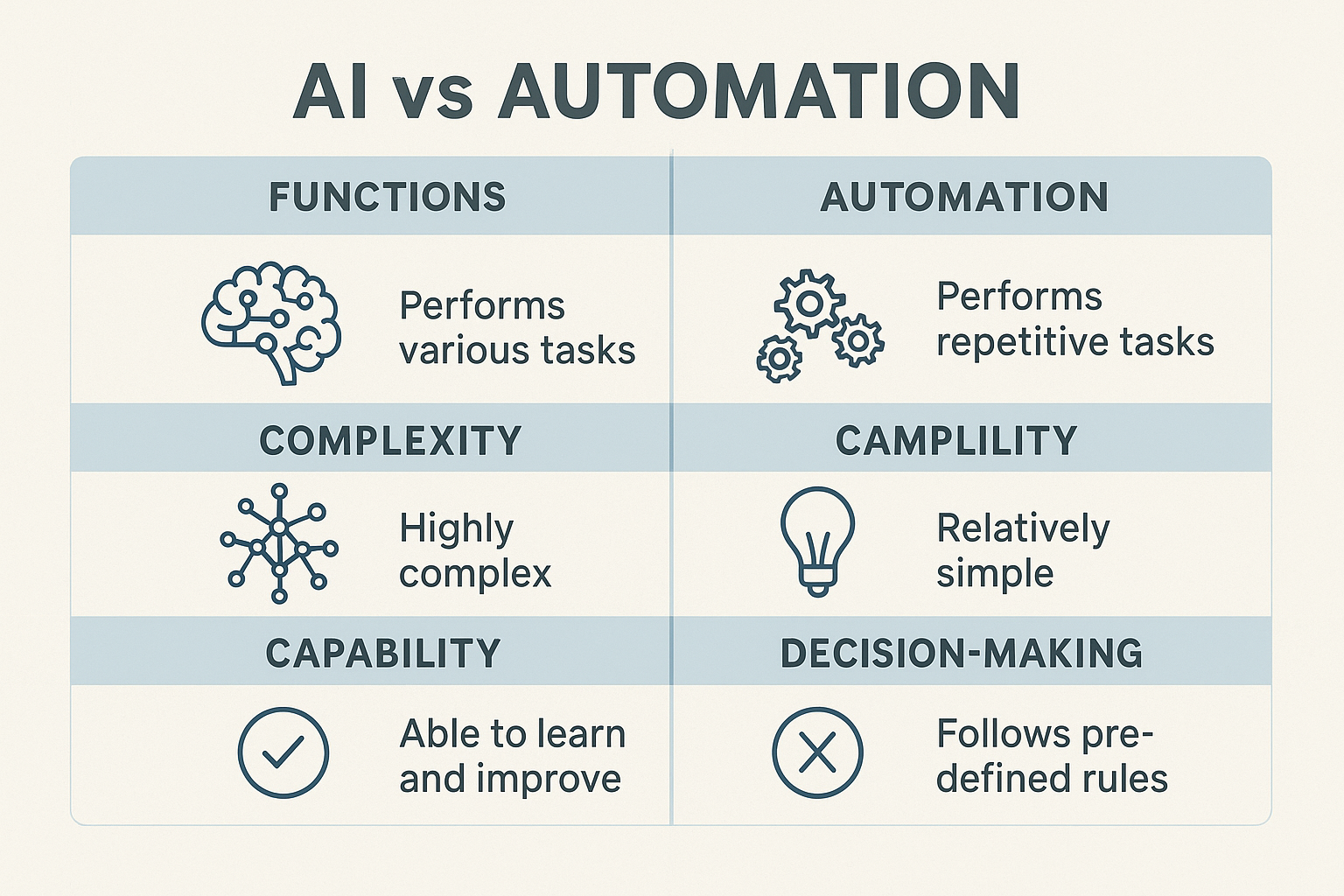
| Feature | Automation | AI |
|---|---|---|
| Function | Executes predefined tasks | Learns from data, adapts |
| Complexity | Low (rule-based) | High (problem-solving) |
| Capability | Reacts to triggers | Predicts, learns, improves |
| Decision-Making | Limited to programmed options | Makes autonomous decisions |
Simply put, automation follows the law; AI interprets and judges.
When to Use Automation
If your work feels like replaying a loop, automation is your go-to:
- Data Entry and Management: Free your mind from tedious tasks.
- Email Campaigns: Schedule newsletters without manual intervention.
- Supply Chain Management: Automate stock reorder to avoid late-night calls.
Pro tip: Tasks with repetitive steps fit automation perfectly.
When to Use AI
For tasks demanding analysis and flexibility, AI shines:
- Customer Service: Chatbots that understand different ways of asking about orders.
- Fraud Detection: Detect suspicious activities faster than ever.
- Personalized Recommendations: Like Netflix predicting your binge-watch cravings.
Remember: Tasks needing adaptability call for AI.
Benefits of AI and Automation
Benefits of Automation
- Efficiency: Works tirelessly like a devoted intern.
- Cost Reduction: Cuts mistakes and frees up human time.
- Consistency: Stable performance without mood swings.
Benefits of AI
- Smarter Decisions: Offers insights and predictions.
- Adaptability: Learns continuously from new data.
- Enhanced Customer Experience: Personalizes interactions deeply.
Bottom line: Automation handles repetitive work; AI tackles complex decisions.
Challenges of AI and Automation
Challenges of Automation
- Inflexibility: Needs reprogramming for changes.
- Initial Costs: Investment can be significant.
- Employment Concerns: Job displacement fears are real.
Challenges of AI
- Complexity and Expense: Development can be difficult and costly.
- Ethical Issues: Privacy, bias, and accountability concerns arise.
- Data Dependency: Quality of output depends on data input.
Keep in mind: Both require careful planning and management.
Finding the Right Balance
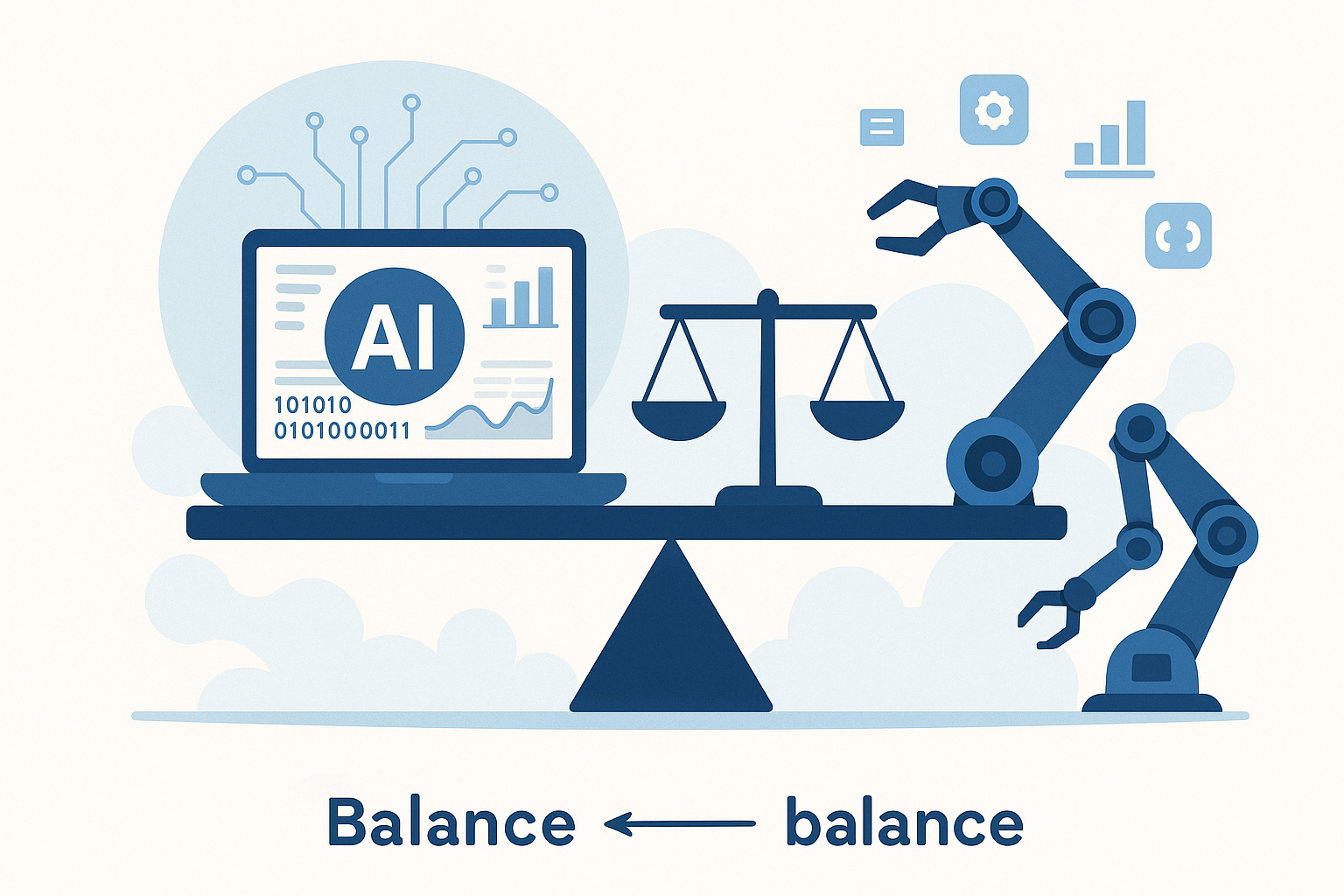
The truth? Automation and AI complement, not compete. Use automation for repetitive, predictable tasks and AI for complex, adaptable challenges. Together, they create smarter, faster, and better workflows — turning work into much more manageable tasks.
FAQs about AI vs. Automation
Q1: Are AI and automation the same?
No, automation follows set rules; AI learns and evolves.
Q2: Can AI enhance automation?
Yes, AI can make automation smarter and more flexible.
Q3: Which industries use them?
Manufacturing, finance, healthcare, retail, and more.
Q4: Where to start?
Begin with automation for repetitive tasks, then introduce AI.
Q5: How to keep AI ethical?
Focus on transparency, fairness, and privacy.
Q6: Is AI already in daily life?
Absolutely — examples include Siri, Alexa, Netflix, Spotify.
Q7: How to get started?
Start small: automate simple tasks, then explore AI tools.
Still here? Great! Now you’re ready to master the AI vs. automation game and let technology take care of the mundane. Consider this your tech-savvy survival guide!
Let’s automate—together.**
🔗 [Book your automation audit](mailto:darrenjohns@productivityloop.ai)